
shoal is a fast, foundational toolkit for clustering in R, with Rust backends behind one consistent interface. Seven clustering algorithms, from k-means to EVoC and graph SLIC, take a numeric matrix or data frame and return one shared result class that prints and plots the same way, with noise points as NA. Alongside them are the building blocks clustering rests on: pairwise distance matrices and exact nearest-neighbour search under nine metrics, and the indices for choosing the number of clusters on evidence. Everything runs multithreaded, and every function matches or improves on the best R and Python alternatives.
| Function | Algorithm | Backend | Reach for it when |
|---|---|---|---|
shoal_kmeans() |
k-means | linfa | Clusters are roughly spherical and you know how many to expect. |
shoal_gmm() |
Gaussian mixture | linfa | Clusters are elliptical, or you want soft memberships and BIC(). |
shoal_dbscan() |
DBSCAN | petal-clustering | Clusters have arbitrary shape and a common density. |
shoal_hdbscan() |
HDBSCAN | petal-clustering | Clusters have arbitrary shape and varying density. |
shoal_hclust() |
Agglomerative hierarchical | kodama | You want a dendrogram and R’s cutree() ecosystem. |
shoal_evoc() |
EVoC | In-tree port of EVoC | Rows are embedding vectors; you want every granularity at once. |
shoal_slic() |
Graph SLIC superpixels | In-tree | Points have coordinates and a neighbour graph; you want compact, homogeneous patches at a chosen scale. |
| Function | Does |
|---|---|
shoal_dist() |
Pairwise distances under nine metrics, returned as R’s own dist so cmdscale(), cluster::pam() and the rest work without glue. |
shoal_knn() |
Exact k-nearest neighbours by kd-tree or parallel scan, same metrics, with a plot() that picks eps for DBSCAN. |
shoal_silhouette(), shoal_metrics()
|
Silhouette widths, Calinski-Harabasz and Davies-Bouldin, for choosing the number of clusters. |
shoal_energy(), shoal_energy_self()
|
Two-sample energy distance between point clouds of any dimension, reduced in parallel without a distance matrix; the self term alone, for reuse across comparisons. |
Installation
# install.packages("pak")
pak::pak("belian-earth/shoal")
Requires a working Rust toolchain (rustc >= 1.81).
A first look
The bundled rings data is three concentric rings plus scattered noise, the case that defeats centroid methods. HDBSCAN finds the rings and labels the noise without being told how many groups to look for.
library(shoal)

fit <- shoal_hdbscan(rings, min_cluster_size = 15L, min_samples = 5L)
fit
#>
#> ── HDBSCAN Clustering
#> Metric: "euclidean"
#> Parameters: alpha = 1, min_samples = 5, min_cluster_size = 15, boruvka = TRUE
#> Clusters: 3, Noise points: 26
#> GLOSH outlier scores: median 0.079, max 0.965

plot(fit)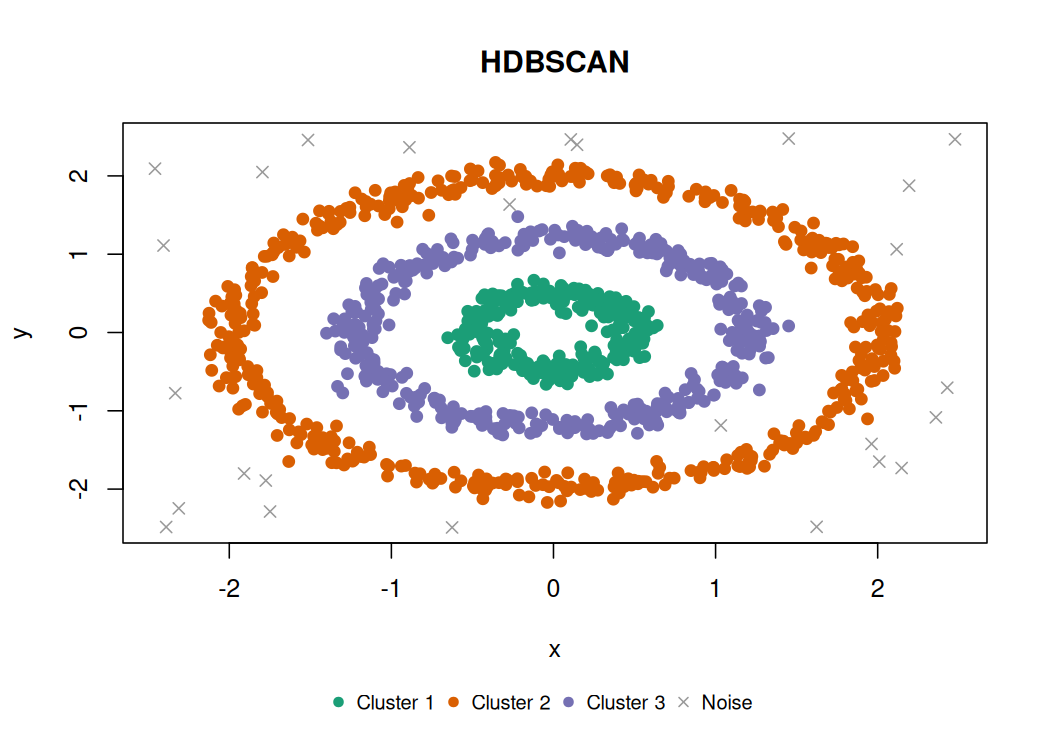
Every algorithm returns the same shape of object: cluster is the assignment, data the matrix it was fitted to, and params records the call. The same plot() and print() serve them all, so swapping one algorithm for another is a one-word change.
The building blocks share the interface. Nearest neighbours of every point, under any of the metrics shoal_dist() offers:
nn <- shoal_knn(rings, k = 5L, metric = "manhattan")
nn
#>
#> ── k-Nearest Neighbours
#> Metric: "manhattan", Search: "kdtree"
#> Points: 1260, Neighbours: 5
#> Distance to neighbour 5: min 0.03437, median 0.1164, max 1.959

head(nn$id, 3)
#>        1   2   3   4   5
#> [1,]   2 165 236 183 283
#> [2,]   1 236 165 183 283
#> [3,] 265 233  59 224   9
Learn more
-
vignette("shoal")introduces each algorithm in turn, with a picture of what it finds, then the distance and neighbour tools and how to choose the number of clusters. -
vignette("distances")is about the choices aroundshoal_dist()andshoal_knn(): which metric, matrix or neighbours, tree or scan, and what to build from a neighbour result. -
vignette("umap")shows what embedding wide data with UMAP does to each algorithm. -
vignette("evoc")clusters real sentence embeddings with EVoC and compares it with the alternatives. - The reference documents every function.
Performance
shoal is built for speed. Every clustering algorithm, the distance matrix and the nearest-neighbour search are benchmarked against the best R alternative and, where one exists, the Python one, at matched settings. Each either matches or improves on them, by margins that grow with the size and dimension of the data. The results, the scaling figure and the scripts that produce them are in bench/README.md.
The Rust backends run their parallel stages on a thread pool owned by the package, which by default uses every logical core. shoal_threads(n) resizes it for the session; options(shoal.threads = n) or RAYON_NUM_THREADS set the default before the package loads. Results never depend on the thread count.
Contributing
Build and workflow notes for working on the package, including the one about timing, are in DEVELOPMENT.md.
Acknowledgements
The algorithms are the work of others. Density-based clustering is bound to petal-clustering by Petabi; hierarchical clustering to kodama, a Rust port of fastcluster; k-means and Gaussian mixtures to linfa; and EVoC to a Rust port of the reference implementation by Leland McInnes and the Tutte Institute, validated against fixtures generated from it. shoal is an R interface to their work.