
Fast Cloud-optimized partial reading of GEDI and ICESat-2 HDF5 data from R. Only the bytes needed for the requested spatial/temporal subset are fetched over HTTP, avoiding multi-gigabyte downloads.
Installation
Requires a Rust toolchain (cargo + rustc).
# install.packages("pak")
pak::pak("belian-earth/spacelaser")
Authentication
All reads go through NASA Earthdata, which requires a free account. Register at https://urs.earthdata.nasa.gov/.
spacelaser authenticates with a bearer token, read from the EARTHDATA_TOKEN environment variable. Mint one with generate_ed_token(), which uses your Earthdata username and password to request a token from NASA and can persist it to ~/.Renviron:
# One-time setup. Reads EARTHDATA_USERNAME / EARTHDATA_PASSWORD,
# or pass username = / password = explicitly.
spacelaser::generate_ed_token(set_renviron = TRUE)
Alternatively, generate a token manually at https://urs.earthdata.nasa.gov/ (Generate Token) and add it to ~/.Renviron:
Tokens are valid for 60 days. When one expires, reads fail with a clear message; run generate_ed_token() again to refresh it, and the new value is picked up on the next read. By default an existing token is reused; pass new = TRUE to force a fresh one (NASA allows two tokens per account).
Example with GEDI L2A
library(spacelaser)

bbox <- sl_bbox(-124.04, 41.39, -124.01, 41.42)

granules <- sl_search(
  bbox,
  product = "L2A",
  date_start = "2022-01-01",
  date_end = "2023-01-01"
)
#> ℹ Searching CMR for GEDI L2A granules
#> ✔ Searching CMR for GEDI L2A granules [686ms]
#>
#> ✔ Found 9 GEDI L2A granules.
gedi2a <- sl_read(granules)
#> ℹ Reading L2A from 9 granules
#> ✔ Read 647 footprints from 20 beams.✔ Reading L2A from 9 granules [42.9s]

gedi2a
#> # A tibble: 647 × 121
#>    beam     shot_number time                lat_lowestmode lon_lowestmode
#>    <chr>        <int64> <dttm>                       <dbl>          <dbl>
#>  1 BEAM0000       1.e17 2022-01-22 01:46:51           41.4          -124.
#>  2 BEAM0000       1.e17 2022-01-22 01:46:51           41.4          -124.
#>  3 BEAM0000       1.e17 2022-01-22 01:46:51           41.4          -124.
#>  4 BEAM0000       1.e17 2022-01-22 01:46:51           41.4          -124.
#>  5 BEAM0000       1.e17 2022-01-22 01:46:51           41.4          -124.
#>  6 BEAM0000       1.e17 2022-01-22 01:46:51           41.4          -124.
#>  7 BEAM0000       1.e17 2022-01-22 01:46:51           41.4          -124.
#>  8 BEAM0000       1.e17 2022-01-22 01:46:51           41.4          -124.
#>  9 BEAM0000       1.e17 2022-01-22 01:46:51           41.4          -124.
#> 10 BEAM0000       1.e17 2022-01-22 01:46:51           41.4          -124.
#> # ℹ 637 more rows
#> # ℹ 116 more variables: degrade_flag <int>, quality_flag <int>,
#> #   sensitivity <dbl>, solar_elevation <dbl>, elev_lowestmode <dbl>,
#> #   elev_highestreturn <dbl>, energy_total <dbl>, num_detectedmodes <int>,
#> #   rh0 <dbl>, rh1 <dbl>, rh2 <dbl>, rh3 <dbl>, rh4 <dbl>, rh5 <dbl>,
#> #   rh6 <dbl>, rh7 <dbl>, rh8 <dbl>, rh9 <dbl>, rh10 <dbl>, rh11 <dbl>,
#> #   rh12 <dbl>, rh13 <dbl>, rh14 <dbl>, rh15 <dbl>, rh16 <dbl>, rh17 <dbl>, …

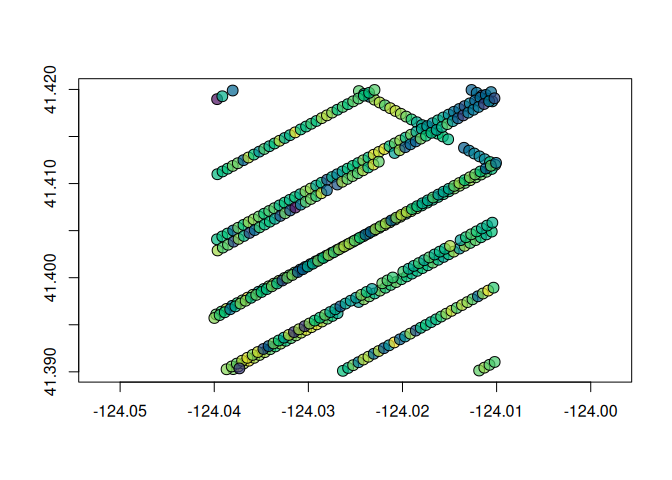
g <- gedi2a[gedi2a$quality_flag == 1, ]

plot(
  g$geometry,
  pch = 21,
  cex = 1.5,
  bg = hcl.colors(100, "Viridis", alpha = 0.7)[
    findInterval(g$rh98, seq(0, 100), all.inside = TRUE)
  ]
)
Exploring other products
sl_columns() lists what a product offers. All 12 GEDI and ICESat-2 products supported by spacelaser use the same two verbs (sl_search() → sl_read()); only the product string and column names change.
# ICESat-2 photon-level data — full column inventory
sl_columns("ATL03", set = "all")
#>                    lat_ph                    lon_ph                      h_ph
#>          "heights/lat_ph"          "heights/lon_ph"            "heights/h_ph"
#>                delta_time            signal_conf_ph            dist_ph_across
#>      "heights/delta_time"  "heights/signal_conf_ph"  "heights/dist_ph_across"
#>             dist_ph_along            pce_mframe_cnt             ph_id_channel
#>   "heights/dist_ph_along"  "heights/pce_mframe_cnt"   "heights/ph_id_channel"
#>               ph_id_count               ph_id_pulse                quality_ph
#>     "heights/ph_id_count"     "heights/ph_id_pulse"      "heights/quality_ph"
#>           signal_class_ph                 weight_ph
#> "heights/signal_class_ph"       "heights/weight_ph"
Supported products
Why spacelaser
The standard R workflow for GEDI / ICESat-2 data is to download whole HDF5 granules, then filter locally. For a typical spatial subset query that wastes minutes and gigabytes — the file you’re filtering is usually orders of magnitude larger than the answer you actually want.
Spacelaser sends HTTP range requests against the remote files and returns just the rows that fall inside your bounding box, with no local caching needed.
On a representative Mondah Forest workload (11 GEDI L2A granules, two years of coverage, 1,376 matching shots) spacelaser completes in ~60 s versus ~1,170 s for a full-granule download + hdf5r read — around 19× quicker for the same 112 shared columns, bit-for-bit identical output. See benchmarks/ for methodology and comparisons with other partial-read and pre-indexed approaches.
Acknowledgements
spacelaser is a Rust reimplementation of the partial-HDF5 reading approach pioneered by h5coro (NASA SlideRule Earth). The core idea is theirs: targeted HTTP range requests against cloud-hosted HDF5 granules rather than downloading whole files. This package brings that idea to R with a GEDI/ICESat-2-specific API and a ground-up Rust parser.