a5pyramid builds level-of-detail pyramids of A5 cells and writes them, with the cells they summarise, to one Parquet file laid out for the browser. A web map reads the file’s footer, picks the level for its zoom and fetches only the tiles in view with HTTP range requests, for example with hyparquet and deck.gl. No tile server and no pre-cut tile directory are needed: one static file serves every zoom.
It takes cells from a5R and a5px. The engine is a Rust crate with no R dependency, in src/rust/a5pyramid, to be published on its own.
| Build |
a5_pyramid() builds the levels as a tibble; a5_write_pyramid() builds and writes them to Parquet in Rust, in parallel; a5_pyramid_arrow() returns the same tiles in memory as an Arrow table, without a file |
| Reduce | mean, sum, min, max, mode, or a representative leaf that keeps real combinations of values such as colours; a mean of codes, such as AEF embeddings, is taken on the values they decode to |
| Read |
a5_pyramid_info() reads the index from the footer; a5_read_pyramid() reads levels within a bounding box, as a renderer does |
| Sets |
a5_write_pyramid_set() splits a pyramid too large for one file into shards, each a small file around one coarse cell, with an index, set.json, so a browser opens only the shards in view |
| Format | One tile per Parquet row group (or Arrow record batch), with each tile’s level and bounding box indexed in the metadata; specified in FORMAT.md
|
Installation
a5pyramid is not on CRAN. Install the development version from GitHub:
# install.packages("pak")
pak::pak("belian-earth/a5pyramid")
Building from source needs a Rust toolchain with rustc 1.88 or later.
Example
s2_santiago, from a5view, holds 15,626 resolution-18 cells (about 22 m across) of a cloud-free Sentinel-2 mosaic over Santiago, Chile, with the blue, green, red and near-infrared bands. This writes a pyramid of it with a representative leaf for the bands, so a coarse cell keeps the colour of a real pixel rather than a blend, and the mean NDVI.
library(a5pyramid)

santiago <- a5view::s2_santiago
santiago$ndvi <- with(santiago, (B08 - B04) / (B08 + B04))

path <- tempfile(fileext = ".parquet")
a5_write_pyramid(
  santiago, path,
  aggregate = "rep_child",
  reducers = c(ndvi = "mean"),
  types = c(B02 = "uint16", B03 = "uint16", B04 = "uint16", B08 = "uint16", ndvi = "float32")
)
info <- a5_pyramid_info(path)
info
#> ── a5pyramid file 'filec01de20b7c3ad.parquet' ──────────────────────────────────
#> Size: 380.3 KB (footer 10.8 KB)
#> A5 index: 1.0
#> Leaves: resolution 18, 15,626 cells
#> LODs: 2-18 (17 levels)
#> Rows: 21,077
#> Tiles: 22 row groups (tile size 4096)
#> Columns: B02 <uint16, rep_child>, B03 <uint16, rep_child>, B04 <uint16,
#> rep_child>, B08 <uint16, rep_child>, ndvi <float32, mean>
#> Bbox: -70.6722, -33.4801, -70.6418, -33.4549
#> Written by: a5pyramid 0.0.0.9000, a5 crate 1.0.0
Every coarser level groups the leaves by the cell containing their centres, so each level partitions the data and ncell counts the leaves under each cell. A browser opening the file reads the footer only, here 11 KB, and then the tiles it draws. a5_read_pyramid() reads levels the same way:
library(ggplot2)

levels <- a5_read_pyramid(path, lod = c(14, 16, 18))
ggplot(levels, aes(cell = cell, fill = a5view::cells_rgb(B04, B03, B02, range = c(300, 2800)))) +
  a5view::geom_a5() +
  facet_wrap(~ paste("LOD", lod)) +
  theme_void()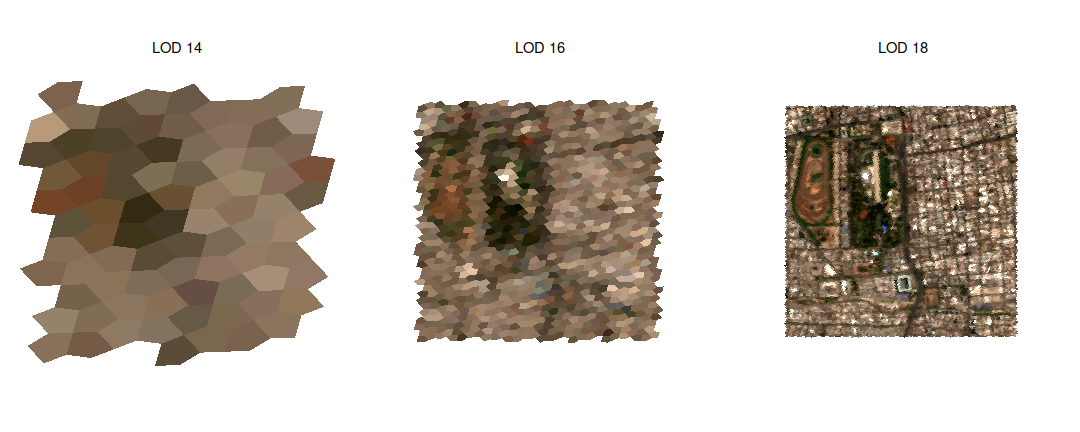
How it works
Levels. A cell at LOD r summarises the leaves whose centres it contains (a5R::a5_cell_to_supercell()). Supercells do not chain: a leaf’s supercell two resolutions up is often not the supercell of its supercell one resolution up, so every level is grouped from the leaves directly.
Tiles. Each level is split into tiles of at most tile_size rows, one Parquet row group each. A tile is a run of consecutive cell ids, and A5 ids follow a space-filling curve, so a run is a compact patch of the globe. Levels are split down the A5 hierarchy only where a run holds more cells than fit a tile, so tiles are coarse where data is sparse and fine where it is dense, and every level stays sorted by cell id. With row_group_size, a row group holds several tiles, each one data page located through the Parquet page index, so an engine that scans whole row groups, such as DuckDB over S3, makes fewer requests while a browser still reads one tile at a time (format version 4).
Index. The file’s key-value metadata holds a JSON index of the levels, the value columns, and the bounding box of every tile, computed from the cells’ boundaries (antimeridian and poles included). Cell ids are delta encoded, which takes them from 8 bytes per row to about 3, and Snappy compression keeps the file readable by hyparquet with no extra libraries. The test suite reads files with hyparquet under Node and checks that only the footer and the requested tile are fetched.
Performance
A pyramid of 439,276 resolution-16 cells over central Scotland, with four uint8 colour channels and a float32 value, builds and writes in about 0.55 s on 20 threads with either mean or rep_child (benchmarks/bench-write.R). The file is 6.5 MB in 172 tiles, with a 78 KB footer. Results do not depend on the number of threads, which a5pyramid_threads() sets.